



Who We Are
Jenni Morella Alaska Department of Fish and Game
Why are we sampling?
Pacific herring are an important forage fish in Prince William Sound, supporting marine mammals, seabirds, and commercially important fish species. Each spring, herring gather in large schools along the coastline to spawn, providing an opportunity to monitor the size, distribution, and age composition of the spawning population.
We conduct annual aerial and biological surveys to track changes in herring spawning activity and collect information needed to estimate population abundance. These observations contribute to long-term monitoring efforts and provide essential data for the age-structured assessment model used to estimate spawning biomass and forecast future population trends.
Aerial surveys have been conducted each spring since 1972, providing one of the longest continuous records of herring spawning activity in Prince William Sound. This information helps researchers understand changes in spawning patterns and supports fisheries management decisions.
Where are we sampling?
Our surveys focus on traditional Pacific herring spawning areas throughout Prince William Sound, Alaska. Each spring, we survey coastal waters to document where and when herring gather to spawn, as well as the extent of spawning activity along the shoreline.
We also collect biological samples from spawning aggregations at selected locations to assess the age composition, size, and condition of the spawning population. These data help us identify differences among spawning areas and track changes in population structure over time.
How are we sampling?
We use aerial surveys to document the distribution and extent of Pacific herring spawning activity throughout Prince William Sound. During each flight, observers record the location and length of visible spawn, as well as the distribution of herring schools, seabirds, and marine mammals. Observations are entered into electronic tablets, and photographs are collected to verify the distribution of spawning activity.
One of the primary measurements collected during aerial surveys is mile-days of spawn, which combines the length of observed spawning activity with the number of days it is documented. For each survey flight, researchers record the miles of spawn observed. These measurements are then added together across the spawning season to produce an annual index of spawning activity.
We also collect herring using seines and cast nets. Fish are frozen and later analyzed to determine their age, length, weight, sex, and reproductive maturity. These biological samples provide information about the age structure and condition of the spawning population and are shared with other research projects investigating herring disease, maturity, and population dynamics.
Together, aerial observations and biological sampling provide important information for estimating herring abundance and evaluating changes in the population over time.
What are we finding?
Long-term aerial surveys provide a valuable record of changes in Pacific herring spawning distribution, timing, and intensity throughout Prince William Sound. In 2025, poor weather limited survey effort during key spawning events, reducing the number of flights and the amount of spawning activity that could be documented.
As a result, the observed mile-days-of-spawn measurement was lower than expected and should be considered incomplete. However, additional observations from local communities and the commercial open pound fishery suggest that spawning was more extensive than aerial surveys alone indicated. These findings highlight the importance of combining multiple sources of information to accurately assess spawning activity, particularly in years when weather limits survey coverage.
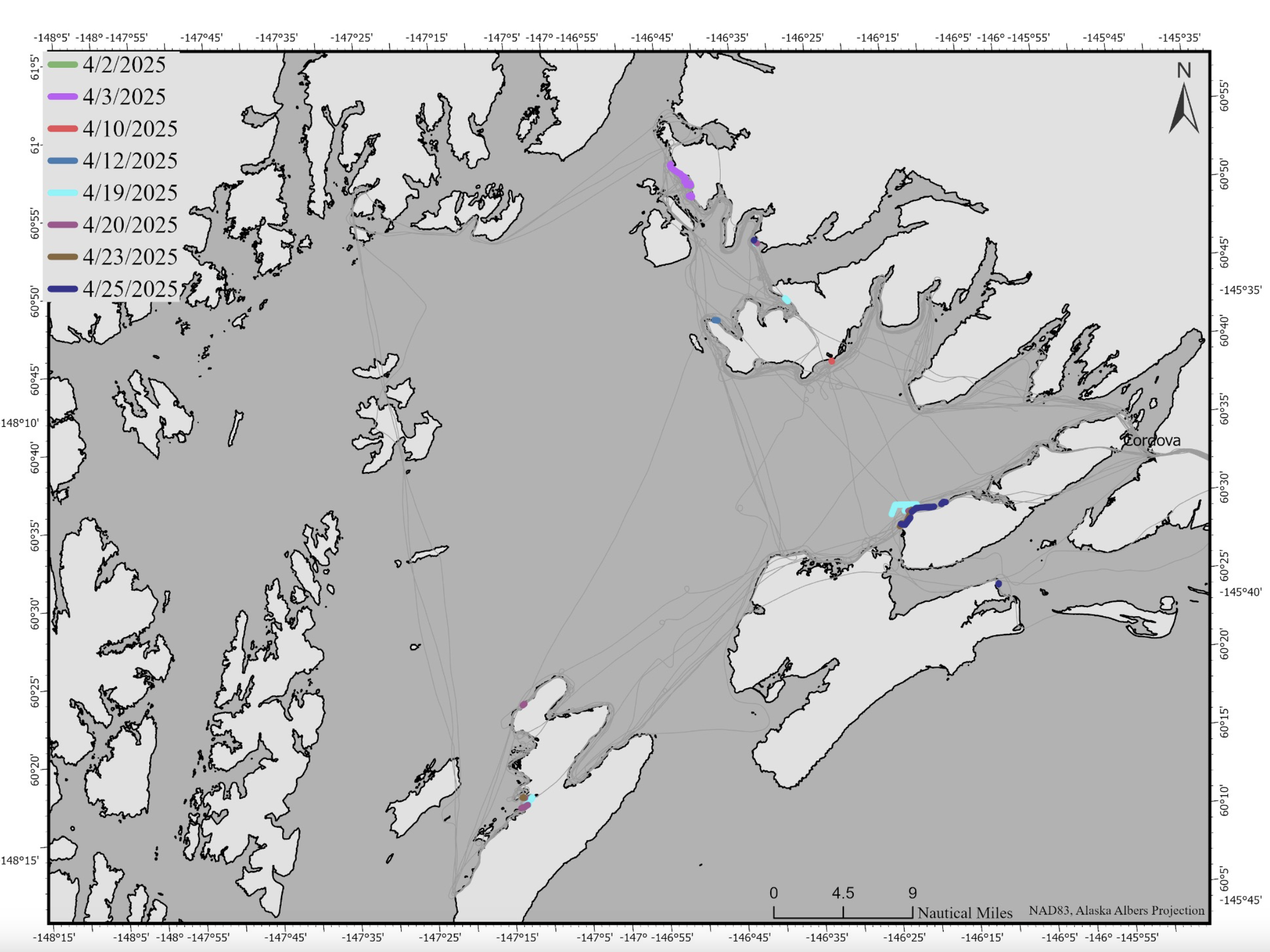
Prince William Sound herring spawn distribution by date for 2025.
Biological sampling conducted during the 2025 spawning season showed that the population was composed of multiple age classes, with age-3 herring representing the largest proportion of sampled fish. The presence of several age classes suggests that multiple year classes continue to contribute to the spawning population, providing important information about population structure and recruitment.
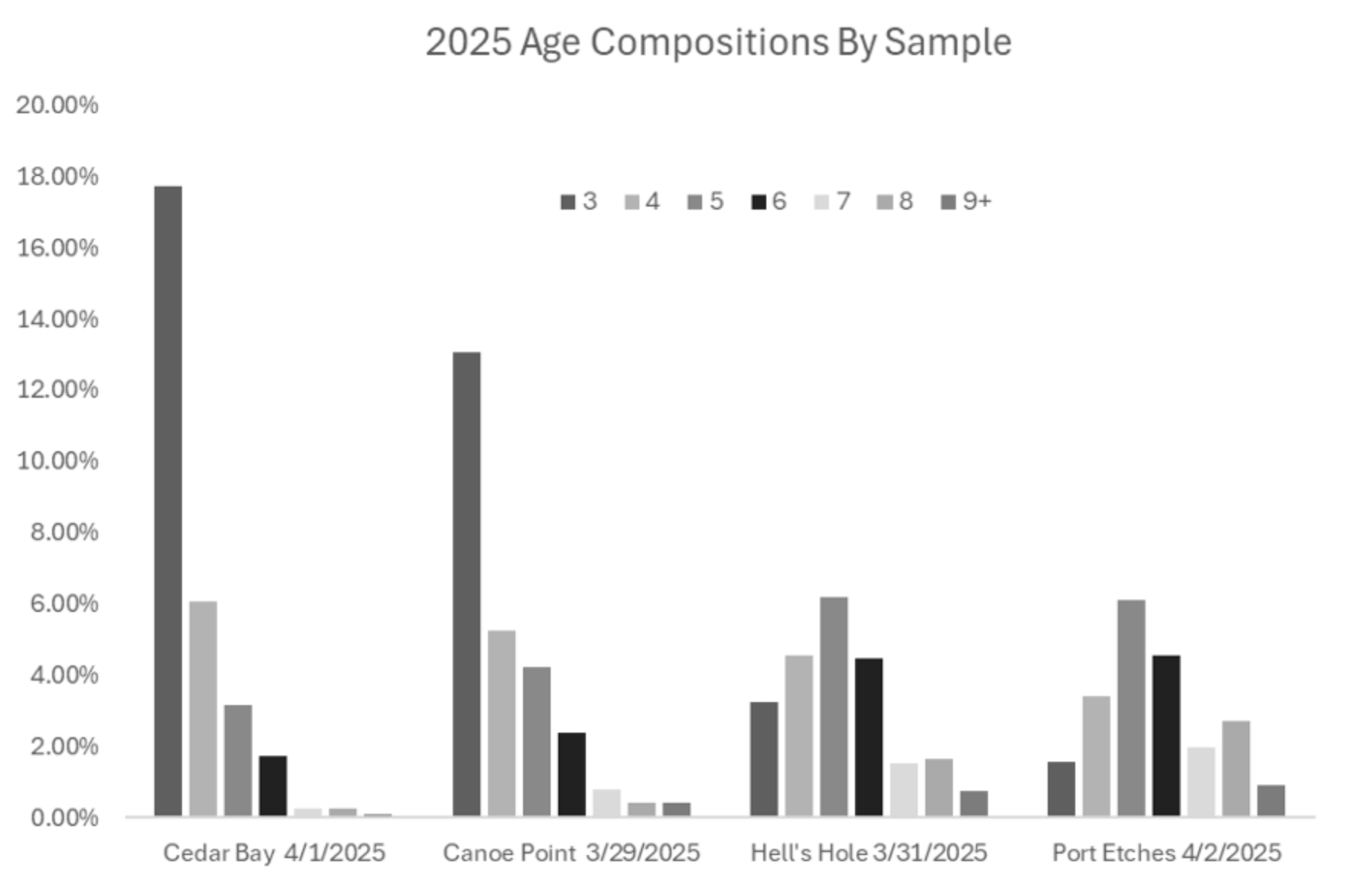
2025 Prince William Sound herring spawning biomass age composition by sample location.
Together, these findings demonstrate the continued importance of long-term spawning surveys for understanding changes in herring abundance, distribution, and population structure. Continued monitoring, supported by local observations and complementary research, will help improve population estimates and provide reliable information for fisheries management, particularly as environmental conditions influence survey effort and spawning dynamics.